
How to Read a Knitting Pattern: Abbreviations, Repeats and Gauge
Learn how to read a knitting pattern: decode abbreviations, asterisk and bracket repeats, and gauge, with a quick reference table and a start-to-finish routine.
 Save
A knitting pattern is a set of short-hand instructions, and most of it comes down to three things: a list of abbreviations, a few punctuation marks that tell you what to repeat, and a gauge that tells you how to match the designer’s size. Once you can decode those three, almost any beginner pattern becomes readable one line at a time.
Quick answer
Read the whole pattern before you cast on. Check the materials and gauge, look up every abbreviation you do not know, and mark the repeats with a pencil or highlighter. Then knit a swatch, and only start the project when the swatch matches the stated gauge.
What a pattern usually contains
Layouts vary by designer, but most patterns follow the same order. Knowing where to look saves a lot of confusion.
| Section | What it tells you | What to check |
|---|---|---|
| Skill level and size | How experienced you need to be and which finished sizes are offered | Pick your size before anything else and circle the numbers that go with it |
| Materials | Yarn, needles and extras such as stitch markers | Compare the yarn weight and needle size with what you own |
| Gauge | How many stitches and rows should fit in a set measurement | Knit a swatch and measure it |
| Abbreviations | Short forms used in the instructions | Look up unfamiliar ones before starting |
| Instructions | Cast on, rows or rounds, shaping and bind off | Read each row to the end, including notes in brackets |
| Finishing | Weaving in ends, blocking, seams and extras | Plan the extra time and tools |
Many patterns list several sizes in a row, for example “Cast on 40 (44, 48) stitches”. The first number is for the smallest size and the numbers in brackets are for the larger ones. Highlighting your size throughout the pattern before you begin makes it much easier to stay on track.
Common abbreviations
You do not need to memorize a long glossary. These appear in most beginner patterns, and the full list is always worth keeping nearby.
| Abbreviation | Meaning |
|---|---|
| K | Knit |
| P | Purl |
| CO | Cast on |
| BO | Bind off (also called casting off in the UK) |
| St / sts | Stitch / stitches |
| Inc | Increase (add a stitch) |
| Dec | Decrease (remove a stitch) |
| K2tog | Knit two stitches together, a right-leaning decrease |
| SSK | Slip two stitches knitwise, then knit them together, a left-leaning decrease |
| YO | Yarn over, which makes an extra stitch and a small hole |
| Rep | Repeat |
| RS / WS | Right side / wrong side of the work |
| Sl | Slip a stitch from one needle to the other without knitting it |
| PM | Place marker |
| Beg | Beginning |
| Cont | Continue |
| MC / CC | Main color / contrasting color |
Some terms are phrases rather than letters. “Work even” means to continue in the pattern without shaping, so the stitch count does not change. “Maintain pattern as established” means to keep the stitch pattern in the middle going while you add or remove stitches at the edges. “At the same time” means two instructions happen together.
How to read repeats: asterisks, brackets and parentheses
Punctuation is where many beginners get stuck, but the rules are simple.
- Asterisk (*) marks the start of a repeat. In “*K2, P2; rep from * across, end K2”, you work K2, P2 again and again until the instruction says to stop. This example makes a ribbing.
- Square brackets [ ] enclose steps that you repeat a set number of times. The count follows the bracket, so “[YO, K2tog] 6 times” gives you six yarn overs and six decreases.
- Parentheses ( ) often group stitches that all go into a single stitch, such as “(K1, P1, K1) in next st”. They can also hold extra size information, so check how the designer uses them.
When a row is long, write the repeat on a sticky note or say it aloud once as you work. Count your stitches at the end of the row if the pattern gives a stitch count, usually shown in brackets at the end of a line.
Right side, wrong side and stitch patterns
Patterns name the two faces of the fabric as right side (RS) and wrong side (WS). When you work flat, back and forth, you turn the work at the end of each row, so RS and WS rows alternate. When you knit in the round, such as for a hat or socks, you work in rounds on circular or double-pointed needles and the same side faces you all the time.
A few stitch pattern names show up constantly:
| Name | What you do |
|---|---|
| Garter stitch | Knit every row |
| Stockinette stitch (St st) | Alternate knit rows and purl rows |
| Reverse stockinette | Same as stockinette, but the purl side is used as the right side |
| Ribbing | Alternate knits and purls in the same row, such as K2, P2 |
For garments, “left” and “right” refer to the wearer’s left and right, not yours. “Work same as left, reversing shaping” means to mirror the first piece. Sketching the shaping on paper first helps you see what to reverse.
Gauge: the part people skip
Gauge is the number of stitches and rows that fit into a given width and height. Each knitter’s tension is different, so the pattern states a gauge to tell you how your fabric should measure to produce the designer’s finished size. A swatch is the test piece.
- Knit a sample swatch, generally about 4 inches (10 cm) square, using the yarn and needles the pattern suggests. If the pattern works in rounds, follow its swatch instructions.
- Lay the swatch flat and measure it. If it measures 4 by 4 inches, you can begin.
- If it does not match, change your needle size by one or two sizes. Go up a size if the swatch comes out too small, and down a size if it comes out too large.
- Expect to make more than one swatch the first time. It gets easier as you learn your own tension.
Gauge decides whether a sweater fits, but it matters for hats, shawls and home items too. A pattern for a dishcloth worked at different gauges would simply produce cloths of different sizes.
A simple routine for your first pattern
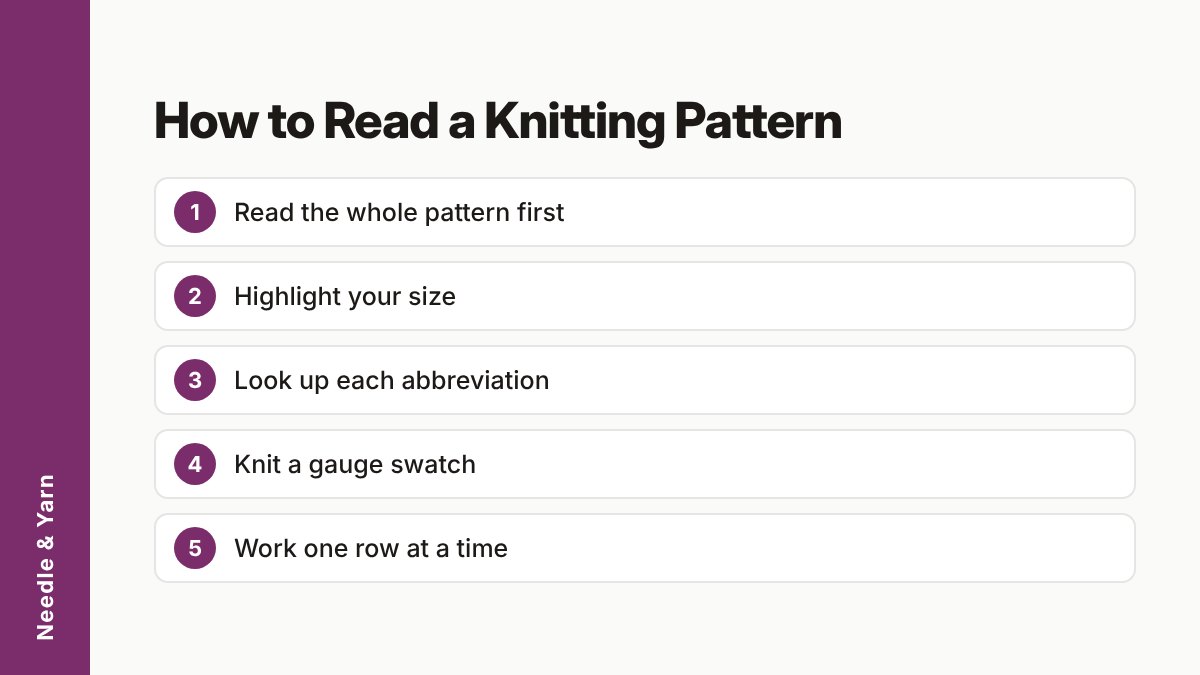
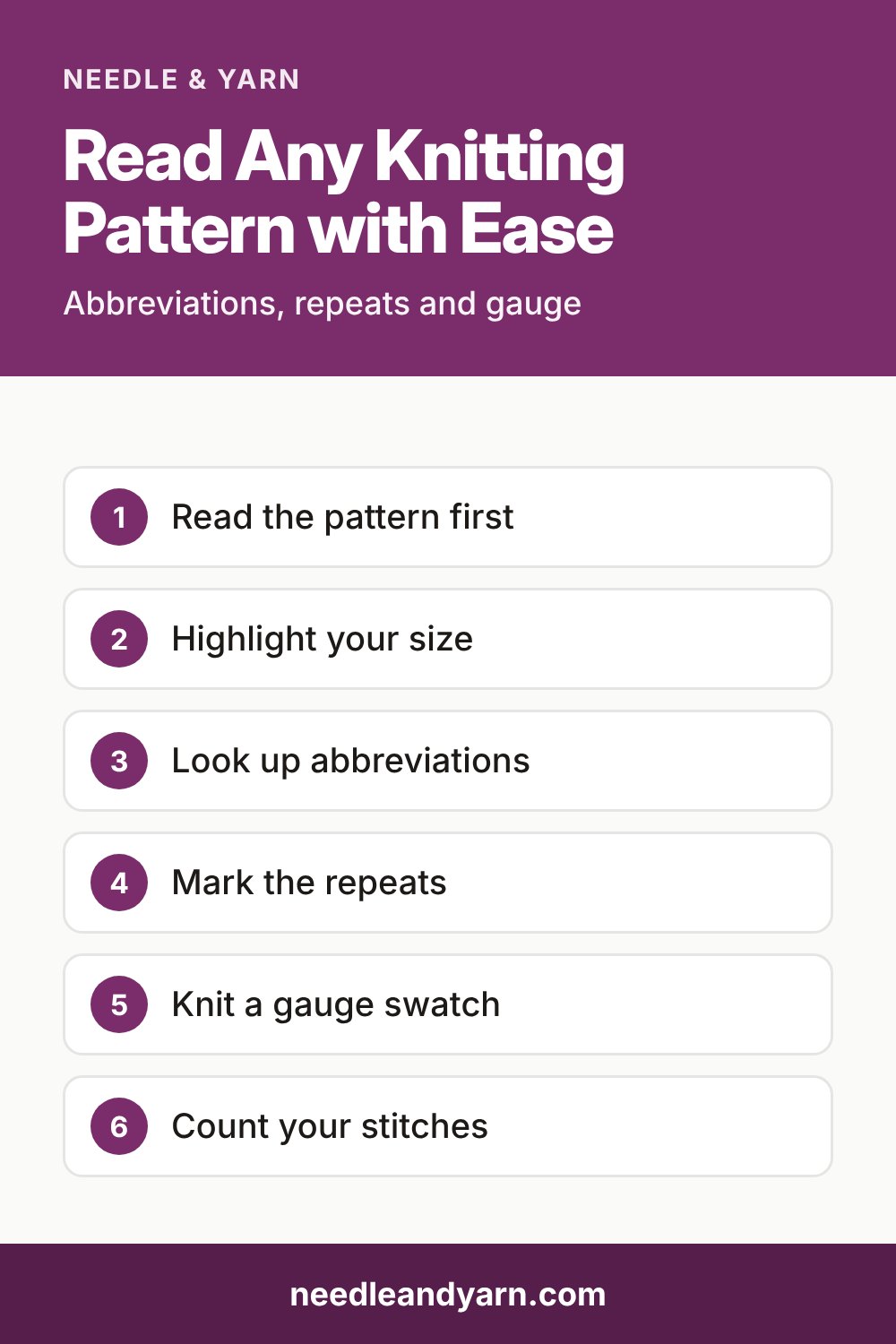
- Read everything first. Look at the sizes, materials, gauge and finishing notes before you buy yarn.
- Highlight your size. Circle every number that applies to you.
- Look up unknown terms. Write the meaning above the abbreviation in pencil.
- Swatch. Match the stated gauge before casting on.
- Work one row at a time. Cross off or tick each row as you finish it, or use a row counter.
- Count stitches regularly. Compare with any stitch counts in the pattern.
Common mistakes
| Mistake | Why it causes trouble | Fix |
|---|---|---|
| Skipping the swatch | The finished piece may be the wrong size | Knit a swatch and adjust needles |
| Reading a line only up to the comma | Notes after the comma often change the next step | Read each row through to the end |
| Following the wrong size column | Stitch counts will not add up | Highlight your size before you start |
| Ignoring “rep from *” | You stop a repeat too early | Mark the repeat and the stop point |
| Forgetting the slip knot is a stitch | Your cast-on count is one short | Count the slip knot as the first stitch in knitting |
| Missing “at the same time” | Shaping goes wrong on one side | Highlight these phrases before you begin |
When a pattern still does not make sense
If a line does not make sense, look for a stitch guide or abbreviation list in the pattern, then compare the written row with a photo of the finished piece. Patterns from other countries may use different terms, for example “cast off” instead of “bind off”. If you still cannot work out a step, ask the pattern’s designer or a local knitting group.
Sources
 Save
Frequently asked questions
What does 'work even' mean in a knitting pattern?
It means to keep going in the stitch pattern you already have without any increases or decreases. The stitch count stays the same.
What is the difference between asterisks and brackets in a pattern?
An asterisk marks the start of a section you repeat across the row, such as '*K2, P2; rep from * across'. Brackets enclose steps you repeat a set number of times, and the number after the bracket tells you how many.
Do I really need to knit a gauge swatch?
Yes, if the finished size matters. Everyone knits with a slightly different tension, and the swatch tells you whether your stitches match the size the pattern was designed for.
What does 'at the same time' mean in a pattern?
It tells you to work two instructions together rather than one after the other, for example shaping the neck while also shaping the armhole.